Renovate, Extend or Rebuild? How to Decide What’s Right for Your Home
You love the location. Perhaps you love parts of the house too.
But the layout doesn’t work, you’re short on space, the kitchen feels disconnected from the garden and the house simply isn’t keeping up with how your family lives.
So what do you do?
Renovate what you have, add an extension or start again?
There isn’t one right answer. The best approach depends on the existing building, your site, your budget and, most importantly, what you’re trying to achieve.
Before jumping straight to an extension or assuming demolition is the answer, it’s worth exploring what your existing home could become.
1. Start with what isn’t working
Before deciding what to build, work out what you’re actually trying to fix.
Do you genuinely need more space, or does the existing space simply work badly?
Perhaps the kitchen is on the wrong side of the house. Maybe circulation takes up too much floor area. You could have rooms that are rarely used while the spaces your family spends most of its time in feel cramped.
Sometimes the answer is additional square footage.
Sometimes it’s a much smarter use of what you already have.
A good starting point is to forget about solutions for a moment and make a list of the problems you want the project to solve.
2. Look for opportunities within the existing house
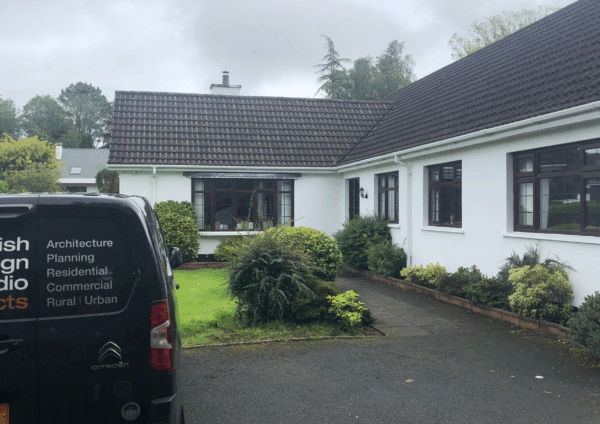
Older homes can contain a surprising amount of underused space.
Changing the internal layout, opening up particular rooms or reconsidering how spaces connect can completely change the way a house feels without dramatically increasing its footprint.
This is where architectural input early in the process can be particularly valuable.
Rather than asking, “Where can we put the extension?”, we can first ask, “What could this house become?”
The answer isn’t always the obvious one.
3. When does an extension make sense?
An extension works best when it adds something the existing house genuinely cannot provide.
That might be a larger kitchen and living space, an additional bedroom, a utility and boot room, better connection to the garden or simply some much-needed breathing room.
But bigger isn’t automatically better.
A successful extension should improve the original house as well as provide additional space.
If you add a beautiful new kitchen but leave behind awkward circulation, dark internal rooms or spaces that no longer have a purpose, you’ve only solved part of the problem.
The old and new parts of the home need to work together.
4. Should an extension match the existing house?
Not necessarily.
Sometimes matching the original architecture is absolutely the right response.
In other situations, allowing the new addition to have its own identity can create a much more interesting result.
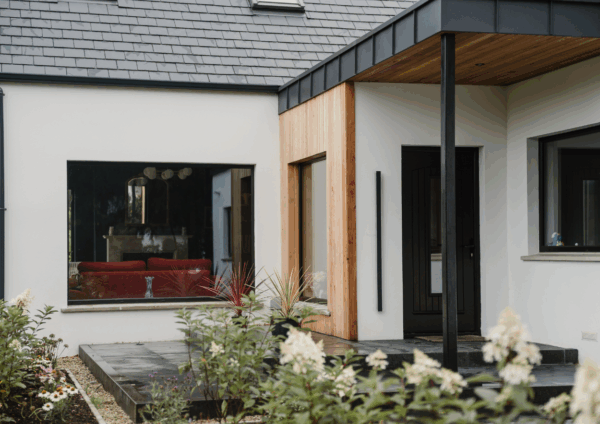
A contemporary extension can sit beautifully alongside an older property when the proportions, materials and relationship between the two have been carefully considered.
The aim isn’t always to make it impossible to tell what’s new.
It’s to make the whole composition feel intentional.
5. When should you consider a more substantial renovation?
If problems exist throughout the house rather than in one particular area, simply adding an extension may not go far enough.
This is where a more comprehensive renovation can make sense.
It gives you the opportunity to reconsider circulation, natural light, energy performance, storage and the relationship between rooms as part of one overall design.
It can also allow the character of an existing property to be retained while making the house much better suited to modern family life.
The key is identifying which elements are worth preserving and which are holding the house back.
6. When might rebuilding be worth exploring?
Sometimes an existing house requires such substantial alteration that it’s worth comparing renovation with the possibility of rebuilding.
That doesn’t automatically mean demolition is the right answer.
The condition and character of the existing building, planning considerations, environmental impact, construction costs and the extent of work required all need to be considered.
But if you’re contemplating major structural alterations, extensive extensions and a complete internal overhaul, it can be useful to understand what the alternatives might look like before committing to one route.
The important thing is to make that decision based on the realities of the particular property rather than assuming one approach will always be cheaper or better.
7. Think about your total budget
Renovation budgets can be deceptive.
It’s easy to focus on the cost of the new extension while forgetting about the work required to the existing house.
New flooring may need to continue through old and new spaces. Heating, electrics and plumbing may need updating. Windows might need replacing. Kitchens and bathrooms can form a significant part of the overall spend.
There may also be structural alterations, repairs and unforeseen issues that only become apparent once work begins.
Think about the whole project, not simply the new square metres being added.
8. Think about how long you want the house to work for you
Your brief shouldn’t only describe how you live today.
Think five, ten or even twenty years ahead.
Will young children become teenagers who want a little more independence? Could you eventually need a home office? Would a downstairs bedroom or shower room make the house more adaptable later in life?
You don’t need to predict every future possibility.
But making a few thoughtful decisions now can allow the house to change with you rather than forcing another major renovation a few years down the line.
Don’t start with the extension
This is perhaps the biggest piece of advice we’d give.
If your home isn’t working, don’t immediately assume you know what needs to be added.
Start with the problems.
Look at the existing house, the site, your budget and how you actually want to live.
Then decide whether the best solution is to renovate, extend, rebuild or perhaps combine elements of more than one approach.
Sometimes the most transformative idea isn’t adding more house.
It’s making the house you already have work much harder.
Considering renovating or extending your home?
At Slemish Design Studio Architects, we look at the existing property as a whole before deciding what should change.
From reworking internal layouts and designing extensions to substantial renovations and transformations, the aim is to create a home that works better for the people living in it.