Before You Buy a Building Site: 7 Things to Check Before Building Your Dream Home
Finding the right site can be the moment a self-build suddenly starts to feel real. You find the location, love the views and can already picture your future home sitting there. But But before you buy a building site, there are some important things worth checking.
1. Is there actually a realistic prospect of getting planning permission?
This is the big one.
A site being advertised as a “building site” doesn’t automatically mean you’ll be able to build the home you have in mind or, in some cases, build at all.
Its planning history, location, surrounding development, local planning policy and any previous applications can all be relevant.
Before purchasing, it’s worth having the site assessed from a planning perspective rather than relying solely on how suitable it appears on the ground.
A great view is a bonus. Planning potential comes first.
2. How will you access the site?
Access is easy to overlook when you’re standing looking at an empty field.
Consider where vehicles will enter and leave, visibility onto the road, gradients and whether there is sufficient space for the access arrangements the site may require.
Then think beyond planning permission.
During construction, diggers, concrete lorries, delivery vehicles and trades all need to reach the site. Once the house is complete, the entrance also needs to work comfortably as part of everyday life.
A difficult access can affect both the design and cost of a project.
3. Where are the services?
Electricity, water, broadband and drainage aren’t particularly exciting compared with designing kitchens and choosing materials, but they’re important questions to ask early.
How far are the nearest connections? Is mains drainage available, or will an alternative wastewater solution be required? Are there existing services crossing the site?
A site that initially appears good value can become considerably more expensive if significant infrastructure is needed before construction even begins.
4. What’s happening below ground?
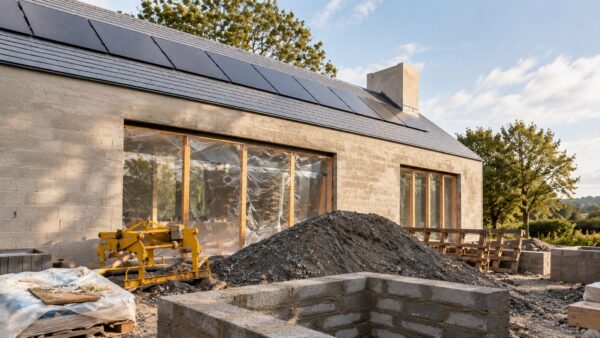
Some of the most expensive parts of a house are the bits you’ll never see when it’s finished.
Ground conditions can influence foundation design, drainage and the amount of excavation required. Poor ground, rock, made-up land or unexpected water conditions can all have cost implications.
You won’t necessarily know everything about a site before purchasing it, but understanding its history and identifying areas that may warrant further investigation can reduce the likelihood of expensive surprises later.
5. Look at the levels, not just the view
A sloping site can create an incredible home.
It can also create additional excavation, retaining structures, drainage requirements and construction costs if it isn’t handled carefully.
Rather than seeing levels purely as a problem, we often look at how the architecture can work with the landscape.
A change in level might create opportunities for split-level living, stronger connections with the garden or a home that sits more naturally within its surroundings.
The important thing is understanding those opportunities and their implications before designing the house.
6. Where does the sun come from?
When you’re viewing a site, take a moment to forget about where you think the front door should go.
Instead, look at its orientation.
Where does morning light arrive? Where will the evening sun fall? Where are the best views? Are there neighbouring properties that need to be considered? Where might you want to sit outside on a summer evening?
Good site design isn’t simply about positioning a house in the middle of a plot.
The orientation of the home can influence everything from the kitchen and living spaces to glazing, garden design, privacy and how the house feels throughout the day.
Sometimes the best layout isn’t the most obvious one.
7. Before you buy a building site, consider the full cost
When comparing potential sites, don’t look at the purchase price in isolation.
There may also be costs associated with access, service connections, drainage, excavation, retaining walls, site clearance, landscaping and external works.
A cheaper site with significant development challenges isn’t necessarily better value than a more expensive site that’s easier to build on.
This is why understanding a site before designing the house can be so valuable. Before you buy a building site, it’s important to consider more than the purchase price alone.
A site should influence the house, not just accommodate it
Some of the most successful homes begin with a really good understanding of the land.
Its orientation, views, neighbouring buildings, landscape and constraints shouldn’t simply be things to overcome. They can become the starting point for the architecture.
Doing your homework before you buy a building site can help you understand both its opportunities and its potential constraints.
Considering a site?
If you’ve found a potential site and aren’t sure what’s possible, an early feasibility assessment can help identify its opportunities and constraints before you commit.
At Slemish Design Studio Architects, we can consider a site from both a planning and architectural perspective, giving you a clearer picture of what may be possible and helping you make a more informed decision about your next step.